
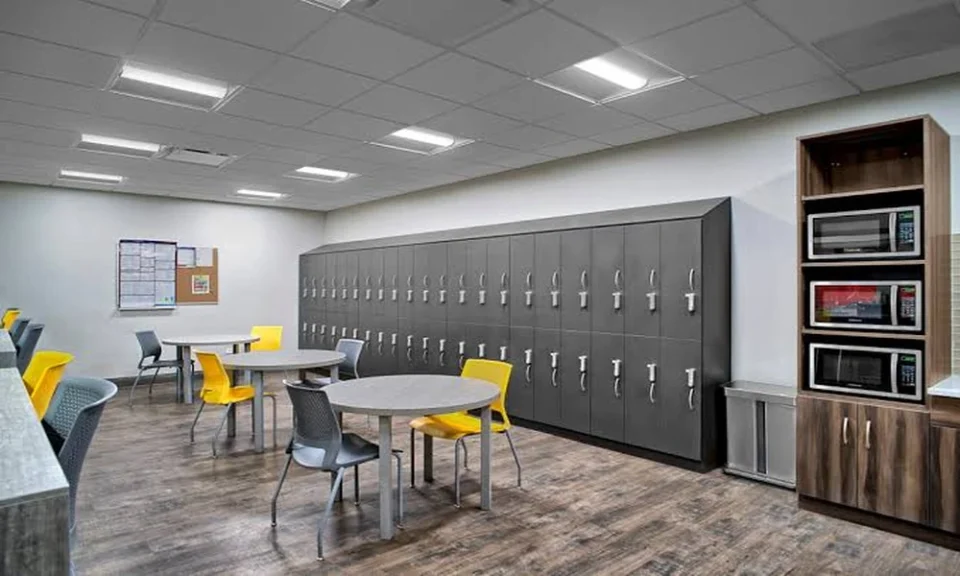
Breakroom lockers became a standard workplace amenity because employers increasingly recognize that secure personal storage supports employee comfort, reduces clutter at workstations, and helps separate personal belongings from production or clinical areas. In hospitals, manufacturing plants, warehouses, and hybrid offices, a locker gives each worker a dependable place for bags, phones, coats, and lunches.
Health care and social assistance is the largest employment sector in the United States (U.S. Bureau of Labor Statistics).
What problems do breakroom lockers solve?
Breakroom lockers solve the problem of where employees keep personal items during a shift when workstations are shared, restricted, or unsuitable for storage. Without dedicated storage, belongings end up on floors, under desks, or in vehicles.
Common problems lockers address
The most common problems lockers address include theft of personal items, clutter in work areas, contamination risk when personal items enter clean or food-handling zones, and the lack of personal space created by shared desks and rotating shifts. Each of these issues affects morale as well as operations.
Which rooms breakroom lockers now serve
Breakroom lockers now serve kitchenettes, nurse areas, lab support rooms, and high-humidity corridors, where HDPE construction with nonporous surfaces simplifies cleaning (ASI Storage Solutions).
How do workplace standards relate to personal storage?
Workplace standards relate to personal storage most directly in industries where employees change into work clothing or protective equipment. Federal sanitation rules address change rooms and separate storage for street clothes and protective clothing where employees wear protective clothing because of possible contamination with toxic materials (Occupational Safety and Health Administration).
How requirements vary
Requirements vary by industry and task. Facility managers and safety professionals should review applicable standards for their specific operations rather than assuming a single rule covers every workplace. Beyond regulatory considerations, employers in offices, hospitals, and retail provide lockers because they improve the working environment.
Why did hybrid and shared workspaces increase demand?
Hybrid and shared workspaces increased demand for lockers because employees who no longer have assigned desks still need somewhere to leave belongings during the day. Hot-desking and hoteling arrangements remove the personal drawer that once served that purpose.
Where day-use lockers sit
In these offices, lockers often sit near entrances, breakrooms, or collaboration zones. Employees store items on arrival, work from any open desk, and retrieve belongings when they leave. Day-use lockers with electronic or combination locks allow assignments to change daily without key management.
What features matter in a breakroom locker?
Features that matter in a breakroom locker include durability, cleanability, security, and appearance. The breakroom is a shared, high-traffic space, and lockers there face daily use, spills, and frequent cleaning.
Priority features for breakroom environments
- Durable construction that resists dents and wear
- Nonporous surfaces that are easy to clean and sanitize
- Reliable locking options, from padlock hasps to built-in locks
- Ventilation to prevent odor from stored lunches and clothing
- A finish and color palette that complements the interior
Breakrooms located near kitchenettes, nurse stations, or lab support areas benefit from materials that tolerate food-adjacent cleaning practices.
How do breakroom lockers support employee well-being?
Breakroom lockers support employee well-being by giving workers a secure, predictable place for personal belongings and by reinforcing the breakroom as a space that belongs to them. Small comforts like a reliable locker contribute to how employees perceive their workplace.
Storage and worker well-being
Workplace policies and environments that advance worker well-being along with safety are the focus of a dedicated federal program (National Institute for Occupational Safety and Health). Thoughtfully designed break areas, including adequate storage, fit within that broader approach to supporting employees during the workday.
How should facilities plan locker quantity and layout?
Facilities should plan locker quantity and layout based on headcount per shift, shift overlap, expected growth, and available wall space. Undersizing forces employees to share or go without, while oversizing wastes floor area.
Planning considerations
- Maximum number of employees on site at shift change
- Whether lockers are assigned permanently or used daily
- Size of items employees typically store
- Clearance for doors to open without blocking circulation
- Accessibility for employees with disabilities
Multi-tier configurations increase capacity in limited floor space, while larger single-tier lockers suit employees who store coats, bags, and equipment together.
What locking options work best in breakrooms?
The locking options that work best in breakrooms depend on whether lockers are permanently assigned or shared among shifts. Permanently assigned lockers often use padlocks or keyed locks, while shared lockers benefit from combination or electronic locks that reset between users.
Electronic and combination lock options
Electronic locks add flexibility and can integrate with employee credentials in some systems. Built-in combination locks reduce lost key issues and allow managers to override access when needed. The best choice balances security, cost, and administrative effort.
How do breakroom lockers affect cleaning routines?
Breakroom lockers affect cleaning routines because their surfaces are touched by multiple employees every shift and sit near food preparation areas. Lockers with smooth, nonporous faces and sloped or closed tops are faster to wipe down than lockers with exposed seams or flat tops that collect clutter and dust.
Designs that speed floor cleaning
Custodial teams benefit from lockers mounted on bases or legs that allow floor cleaning underneath. Clear expectations for employees, such as removing food at the end of each shift, keep interiors from developing odor between cleanings.
Why are breakroom lockers a long-term investment?
Breakroom lockers are a long-term investment because they are used every working day, often for decades, by every employee on site. Selecting durable, cleanable, and appropriately sized lockers from the start avoids premature replacement and keeps the breakroom functional as the workforce changes. Employers that treat personal storage as part of workplace design, rather than an afterthought, create breakrooms that support security, cleanliness, and a better daily experience for their teams.
